 Photoshoot Amsterdam
Red Light District Photography Rules
The red light district photography rules are short, unwritten in law and enforced on the spot: you do not photograph or film sex workers, their clients, or the doorways they work in. Everything else in De Wallen, the church, the canals, the bridges, the murals in the alleys, is ordinary public space where a camera is unremarkable. This page, part of our Amsterdam photoshoot guide, sets out what is banned, who enforces it, what it costs when it goes wrong, and how the rest of Amsterdam's camera restrictions fit around it.
Quick answer The short version: what is banned, the fine, what you can shoot
Photographing or filming the workers in the windows, their clients, or the doorways is forbidden in De Wallen. It is patrolled, including by officers in plain clothes, reported fines run up to €150, and phones get confiscated or worse when window security gets involved. What you may photograph: the Oude Kerk, the canals, the bridges, the gables and the street art in the side alleys. Guided tours of the area were banned outright in 2020, and the group tours that remain may not stop at the windows.
Key takeaways
- The ban covers people and doorways, not the district: the Oude Kerk and the canals are fine
- Reported fines reach €150, and plainclothes enforcement is real rather than theoretical
- Smoking cannabis on the street here has been banned since 25 May 2023, with a €100 fine
- One session on this site walks a De Wallen alley for its wall art. How that works
What Exactly Is Forbidden
The rule is behavioural rather than statutory, which is why it confuses visitors who have read that Dutch law permits photography in public space. Both things are true at once: there is no general law requiring consent to take a picture on a Dutch street, and in De Wallen photographing the people who work there is prohibited, signposted and policed.
The three things that trigger it
A worker in a window. A client at a door. The doorway itself, close enough that either could appear in the frame.
In practice enforcement officers and window security read the direction your camera is pointing, not the resulting file, so a phone raised toward a lit window is the problem whether or not you pressed the shutter. If a window is in your composition, turn around and shoot the other side of the alley.
What it costs
Reported fines run up to €150. Beyond the official penalty, the practical risks are the ones travellers write about afterwards: being asked to delete the photo in front of an officer, having the phone taken, and confrontation with security working for the window operators. None of this requires a court case, and none of it is negotiable at 23:00 on a Saturday.
Why the rule exists
Consent, and decades of the absence of it. Workers in De Wallen have been photographed and filmed for years by people who then posted the images online, sometimes with commentary. The city's answer, alongside the wider effort to reduce pressure on the district, was to make the camera rule explicit and to enforce it.
Read as a request from the people who work there rather than as a tourist regulation, it is not a difficult rule to keep.
The Tour Ban, and What Group Rules Mean for You
Since 1 April 2020 guided tours of the red-light area have been banned outright, with fines for operators that run into thousands of euros. The reasoning was the same as the camera rule: crowds of visitors stopping in narrow lanes to look at people at work, described by the city as a nuisance to both residents and workers. Group tours elsewhere in the centre are tightly restricted and may not stop at the prostitution windows.
For a private photoshoot none of this applies directly, because you are two or three people walking, not a group of twenty with a guide holding an umbrella. It matters in one practical way: a photographer who suggests posing you in front of the windows is either new or careless, and no listing in this catalogue does that. The one session that enters the district, the photo-spots tour with Moco entry, photographs a single alley for its wall paintings and keeps the camera on the paintwork.
What You Can Photograph in De Wallen
More than most visitors realise, because the district is also the oldest part of Amsterdam.
Subject by subject
More than most visitors realise, because the district is also the oldest part of Amsterdam.
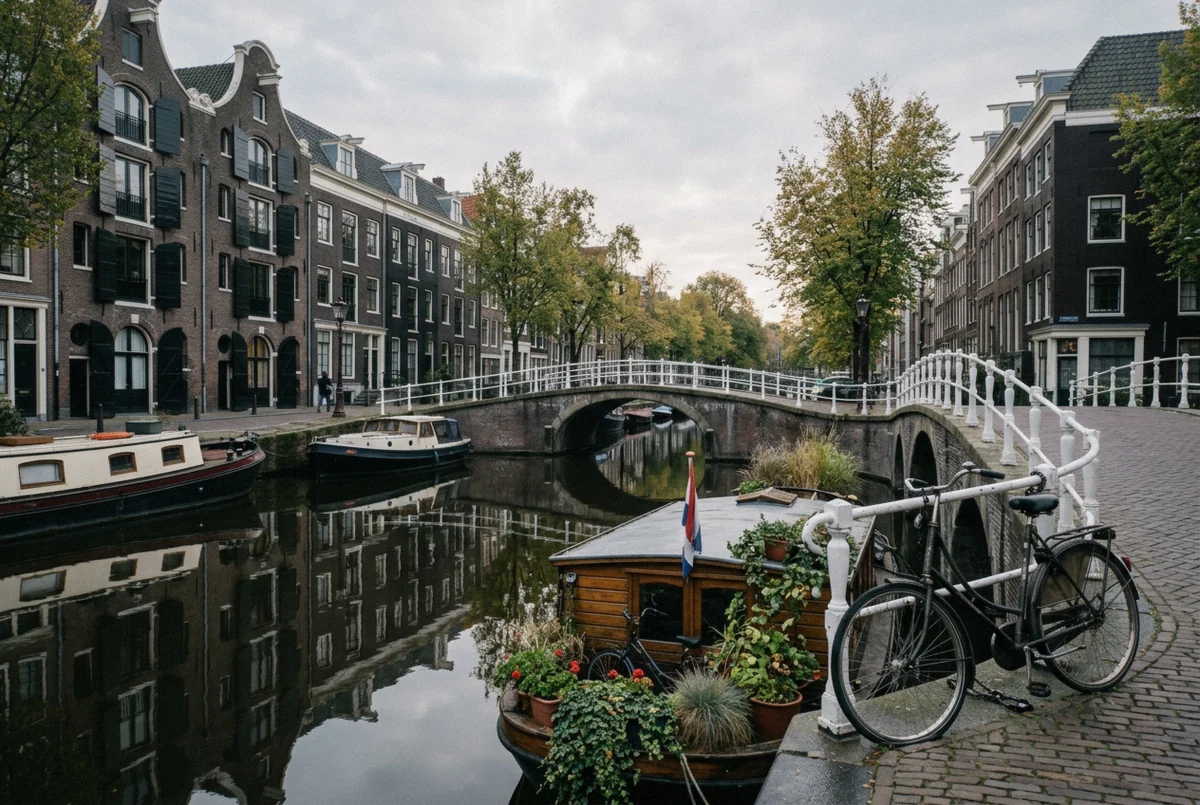
The Oude Kerk is the city's oldest surviving building, consecrated in 1306, and it sits in the middle of the district with a square around it that gives you room to step back, which is rare in this part of town. The canals, the Oudezijds Voorburgwal and the Oudezijds Achterburgwal, carry the same gabled facades and moored houseboats as the more famous rings, with fewer people photographing them. The bridges at the north end frame the church tower cleanly.
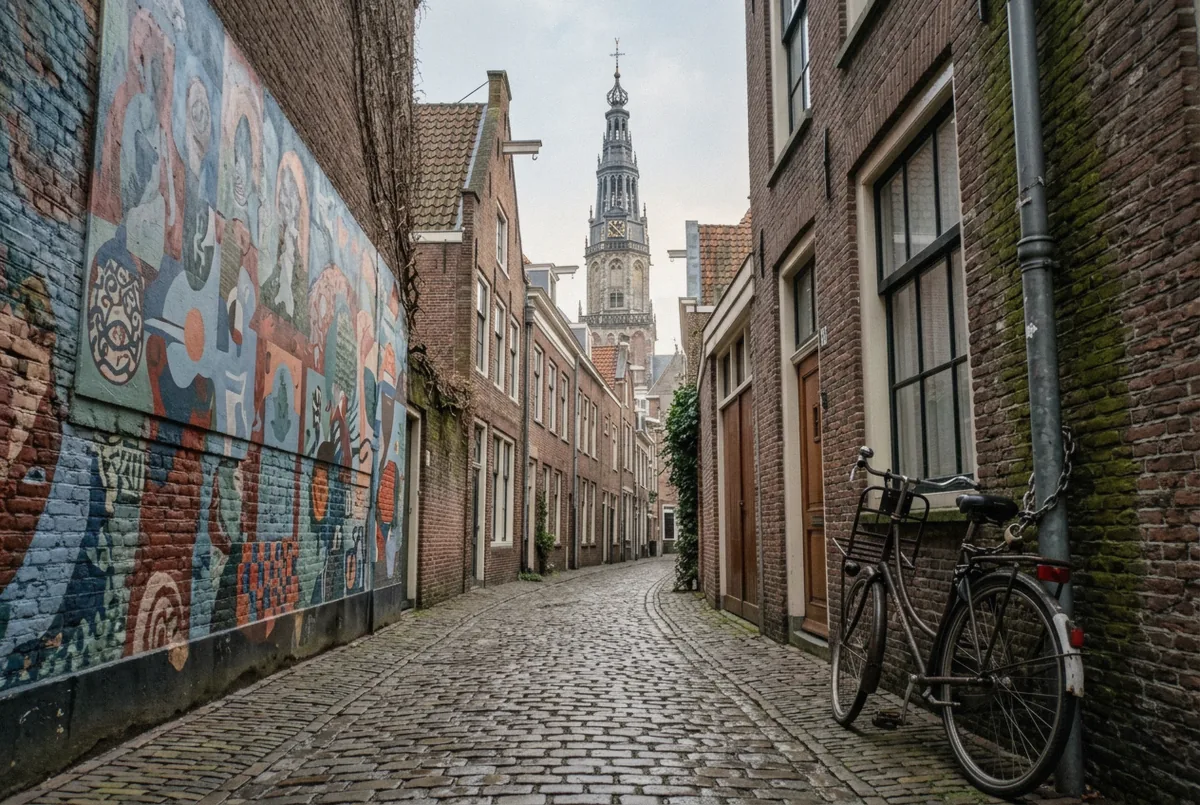
The street art in the side alleys is the other legitimate subject: large murals on brick, stencils and paste-ups that change through the year. In the morning, before the district wakes up, those lanes are quiet, well lit from above and completely usable. That is the window the honest tours use.
What you will not get, and should stop hoping for, is a portrait of yourself with a lit red window as a backdrop. The frame is off limits.
Green light, red light
The distinction is people and doorways, not the district.
| Subject | Allowed? | Note |
|---|---|---|
| Oude Kerk and its square | Yes | Consecrated 1306; the square gives you room to step back |
| Oudezijds canals and bridges | Yes | Same gables and houseboats as the famous rings, fewer cameras |
| Street art in the alleys | Yes | Morning light reaches down between the gables |
| Bars, cafes, shopfronts | Yes | Ask before photographing staff, as anywhere |
| A window with a worker in it | No | Reported fines up to €150, phone seized |
| A client at a door | No | Same rule, same enforcement |
| A doorway close enough to include either | No | Officers read where the camera points |
| A portrait of you with a lit window behind | No | This is the frame people book and cannot have |
Amsterdam's Other Camera Rules
Five more restrictions exist across the city, and only two of them touch a normal photoshoot.
The city's camera rules at a glance
Four restrictions, and what each one actually stops you doing.
| Where | What is restricted | Penalty | Applies to a photoshoot? |
|---|---|---|---|
| De Wallen windows | Photographing workers, clients, doorways | Reported up to €150, phone seized | Yes: every session routes around it |
| De Wallen streets | Guided tours of the area, banned since 1 April 2020 | Thousands of euros for operators | Only to group tours, not private sessions |
| De Wallen, Dam, Damrak, Nieuwmarkt | Smoking cannabis outdoors, since 25 May 2023 | €100 | Indirectly: not in the frame either |
| Begijnhof courtyard | Groups, tours, filming, large cameras; closed after 17:00 | Asked to leave | Yes: phone photography only |
| City centre airspace | Recreational drone flights, Schiphol control zone | From about €250, drone seized | Yes: no listing uses a drone |
| Public space, with a crew | Productions notify the municipality, 3 to 30 working days | Enforcement on site | No: hand-held private sessions are exempt |
The Begijnhof
A walled courtyard of houses off the Spui, inhabited since the Middle Ages and open 09:00 to 17:00. The sign at the gate asks for no groups, no tours, no filming, no bicycles and no dogs; groups over twelve are not admitted, and quiet private photography is tolerated rather than invited. Do not photograph residents or into windows.
The two-hour photography workshop treats it as a smartphone-only stop because DSLRs are not allowed inside, and its 09:00 departure works the surrounding lanes instead.
Drones
Central Amsterdam lies inside Schiphol's control zone, roughly a 14-kilometre radius, which effectively bans Open-category recreational flights across the whole city centre. Reported fines start around €250 and confiscation is on the table. Check the official GoDrone app before flying anywhere in the Netherlands; the outskirts and nearby towns outside the zone are the realistic option.
Professional productions
Filming and photography in public space with a crew and equipment is notified to the municipality in advance. The city's protocol sorts productions into four impact categories with minimum lead times from three working days for the smallest to thirty for the largest, and answers within two working days. A hand-held private portrait session with no crew, no lighting and no vehicles is not what that protocol is aimed at, and none of the sessions in this catalogue files anything for a normal booking.
Cannabis on the street
Not a camera rule, but the one visitors get fined for most often in the same streets: since 25 May 2023 smoking cannabis outdoors has been banned in De Wallen, on Dam Square, along the Damrak and around the Nieuwmarkt, with a €100 fine. If you are being photographed in the centre, this is the area where a lit joint in the frame is also a penalty notice.
How to Photograph the Old Centre Without Getting It Wrong
Go early. Before about 09:00 the district is quiet, the windows are mostly dark, the lanes are empty and the light comes down cleanly between the gables. Everything you actually want, the church, the water, the murals, is available and nothing you are not allowed to photograph is on display.
Keep the camera low between frames. Enforcement reads intent, and a phone held up at chest height while you walk past windows looks the same to an officer, filming or not. Put it away in the two or three lanes where the windows are, and take it out again on the canal.
Ask before photographing anyone anywhere in the centre. Legally you often do not have to; practically, the difference between a good candid frame of a market trader and an argument is one question. This is also true of the photo-spots tour, where the guide does the asking.
If you are booking a photographer, let them route around it: the Amsterdam photoshoot sessions we compare all start elsewhere. Every session in this catalogue works elsewhere by default: the Jordaan canals, the Negen Straatjes, the Staalmeestersbrug and the station front are all outside the district, and the photo spots map marks which sessions shoot where.
Where to Point the Camera Instead
If you want the old centre without the windows
the Oude Kerk square, the Oudezijds canals and the bridges toward Nieuwmarkt, all before 09:00
If you want street art
the side alleys of De Wallen in the morning, which is exactly what the photo-spots tour shoots
If you want a portrait with no rule to remember
the Jordaan canals or the Nine Streets, both a ten-minute walk west
If you want to learn to shoot the centre yourself
the two-hour workshop walks seven locations and tells you where the cameras are not welcome
Photography in the Red Light District: Questions
Are you allowed to take photos in the Red Light District?
You are allowed to photograph the place, not the people who work there. The church, the canals, the bridges, the gables and the alley murals are fair game. Sex workers, their clients and the doorways are not, and that is enforced with reported fines up to €150, plainclothes patrols and window security. In practice: shoot the water side of the alley, not the window side.
What happens if you take a photo of a window?
The likely sequence is being told to stop and to delete it, by an officer or by security working for the operator. Reported fines reach €150. Travellers also describe phones being grabbed. None of that requires a formal process, so there is nothing to argue about on the spot, and no photograph is worth the alternative.
What are the other rules for the Red Light District?
Guided tours of the area have been banned since 1 April 2020, with heavy fines for operators, and remaining group tours may not stop at the windows. Smoking cannabis on the street has been prohibited since 25 May 2023 in De Wallen, on Dam Square, the Damrak and around the Nieuwmarkt, with a €100 fine. Blocking the narrow lanes to gawk is not fined, but it is the behaviour every one of these rules exists to stop.
Can you take street photography without asking for permission in the Netherlands?
In public space, generally yes: Dutch law does not require consent to take a photograph on the street, though publishing an identifiable person commercially is a different question. The Red Light District rule is a local behavioural prohibition enforced on the spot, and the Begijnhof's restrictions are the private courtyard's own. Between those two, ordinary street photography in Amsterdam is unremarkable.
Do photoshoot sessions ever shoot in the district?
One in this catalogue enters it, and only for the wall art: the photo-spots tour with Moco Museum entry walks a single alley for its murals. Every other session works the canal belt, the Jordaan, the east or Zaanse Schans. If a photographer offers you window portraits, book someone else.
Is it legal to photograph people elsewhere in Amsterdam?
On the street, yes, with the usual caveat that a raised camera invites a reaction whether or not the law backs you. Two specific exceptions: the Begijnhof courtyard, where the gate sign bans filming and large cameras and asks you not to photograph residents or into windows, and the district covered above. The photo spots map flags both.