 Photoshoot Amsterdam
Where to Propose in Amsterdam
Choosing where to propose in Amsterdam is a logistics problem dressed as a romantic one. The city has dozens of beautiful bridges, and the difference between them is not beauty: it is whether the spot is quiet at the hour you need it, whether the light will hold, and whether a photographer can stand far enough back to stay invisible. This guide, a companion to our Amsterdam photoshoot comparison, sorts the candidates on those three tests, adds the hour each one works, and names the two parts of the centre to keep away from.
Quick answer The short version: the best spot, the best hour, the cost
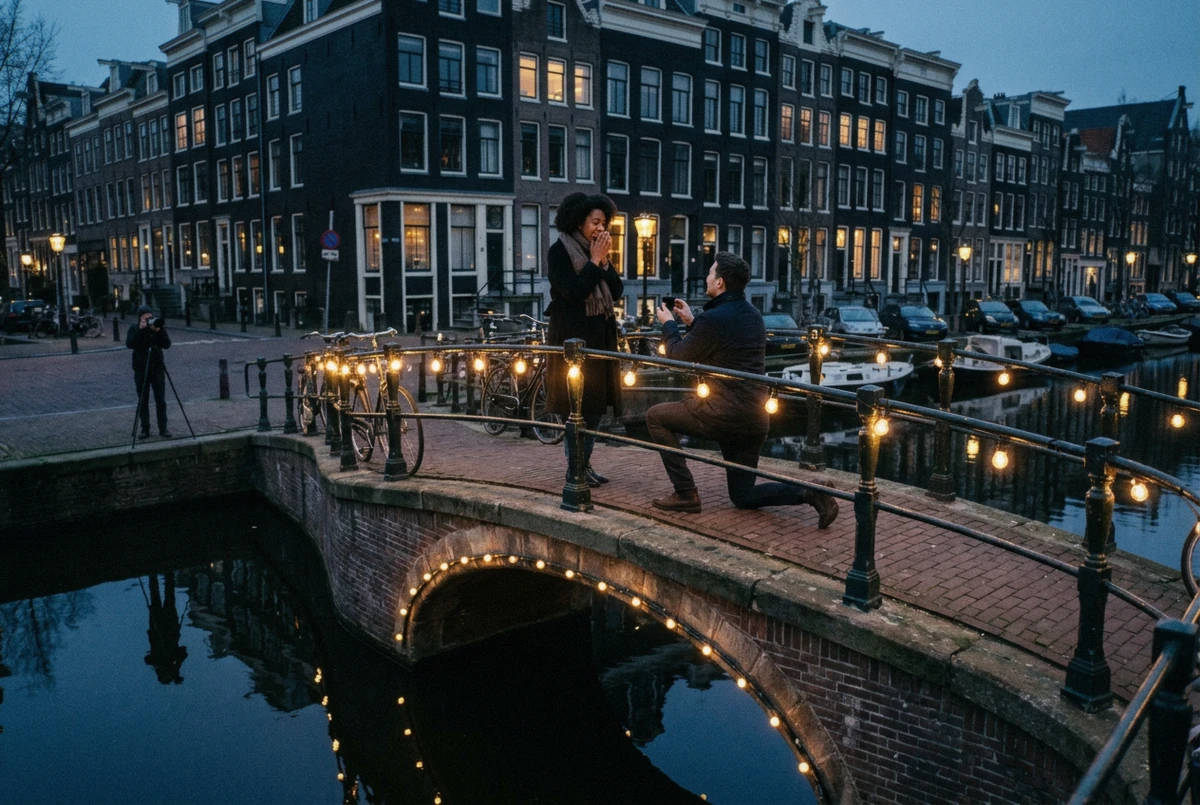
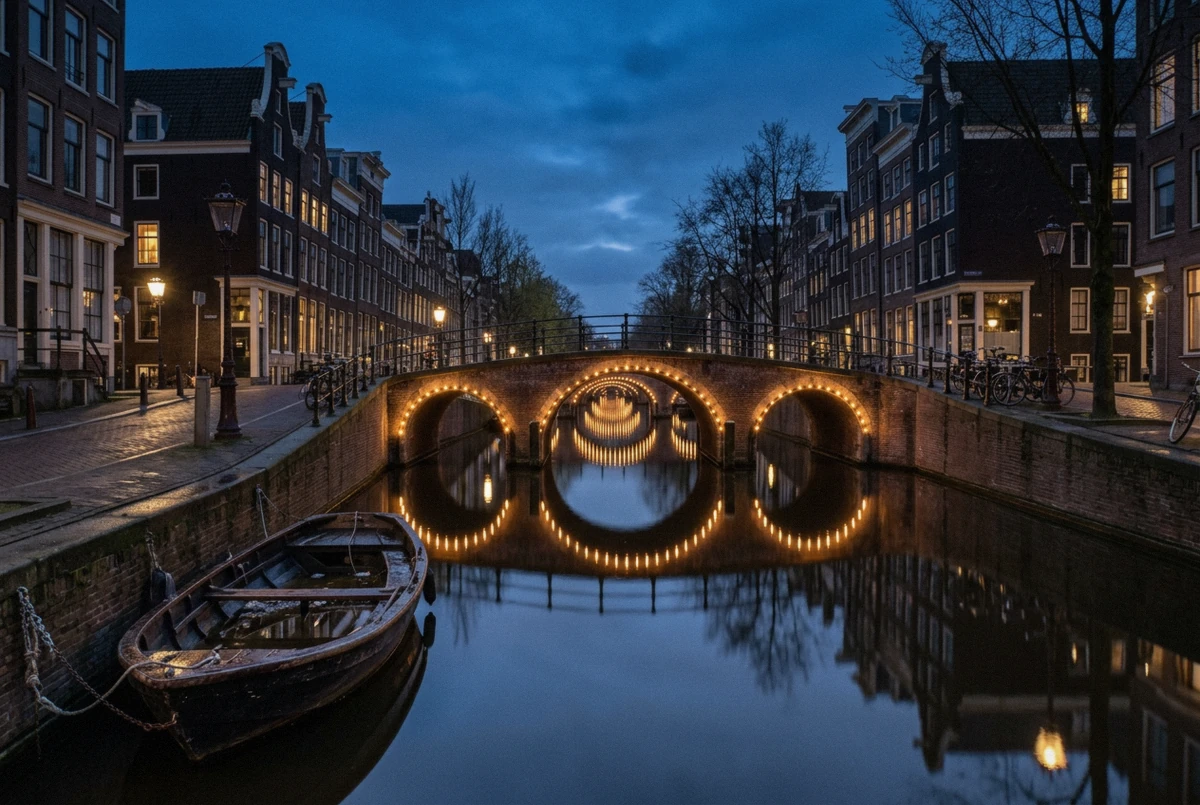
The signature frame is the seven-bridges view down the Reguliersgracht, seen from the Herengracht corner at blue hour, once the bridge lamps are lit. For privacy rather than postcard, the Brouwersgracht and the Jordaan side canals before 09:00 are as beautiful and almost empty. A planned photographer costs $161 on the platform against $425 as the concierge starting price, and the thing that makes it work is not the camera but the plan: a fixed minute, a signal, and a reason for the walk.
Key takeaways
- Best known frame: Reguliersgracht seven bridges at blue hour. Best kept quiet: the Jordaan canals before 09:00
- Avoid the Red Light District, where photographing people is banned and fined up to €150, and the Begijnhof, which closes at 17:00 and bans large cameras
- A discreet photographer is $161 on the proposal session, with 9 to 30 edited photos in three working days
- Blue hour moves by hours across the year: past 22:00 in June, late afternoon in December. Month by month
The Seven Candidates
Each entry gets the same three tests: how private it is, when the light works, and whether a photographer can hide.
Ranked, with the hour that matters
Privacy is scored for the hour listed, not the whole day. All seven sit within reach of the centre on foot or one tram.
| Spot | Best hour | Privacy | Why it works |
|---|---|---|---|
| Reguliersgracht seven bridges | Blue hour | Moderate | Seven lit arches line up down the canal; the frame everyone recognises |
| Brouwersgracht | Before 09:00 | High | Warehouse facades, flat water, almost nobody about |
| Jordaan side canals, Egelantiersgracht and Bloemgracht | Before 09:00 or dusk | High | Narrow, residential, plane trees; a photographer blends in as a local |
| Amstelveld | Late afternoon | High | Plane trees and a white wooden church, one block from the seven bridges |
| Magere Brug | Sunset to blue hour | Moderate | Wide river light, then the bridge bulbs come on |
| Zandhoek, Western Islands | Late afternoon | Very high | Wooden houses and sailing barges; almost no visitors |
| Vondelpark | Golden hour | Moderate | Green rather than brick, and space to step back for a wide frame |
The postcard: Reguliersgracht
Stand on the Herengracht corner looking south and seven arched bridges recede down the water, each strung with lamps that double in the canal. It is the strongest night frame in Amsterdam and the reason blue hour matters here: in daylight the same view is a pleasant canal. The trade-off is company, because it is a known viewpoint, though the crowd is people admiring a view rather than a queue.
It is also on the route of the two-hour photography workshop, which tells you what photographers think of it.
The quiet ones: Brouwersgracht and the Jordaan
If the priority is that nobody watches, go north and west and go early. The Brouwersgracht before 09:00 is the best canal frame in the city with the fewest people in it, and the Jordaan's smaller canals, the Egelantiersgracht and the Bloemgracht, are residential enough that a couple stopping on a bridge attracts no attention at all. This is the hour the canal session prefers, for exactly the same reasons.
The alternatives worth knowing
Amstelveld gives you grass and plane trees a block from the seven-bridges view, which is useful if you want somewhere to sit afterwards. The Magere Brug, the white wooden drawbridge over the Amstel, takes low sun better than any canal because the water is wide, and its bulbs turn on at dusk. Zandhoek on the Western Islands is the most private option on this list and the least photographed part of the old city.
Vondelpark is the one green choice, which matters if a canal is not the memory you want.
Two Places Not to Do This
The Red Light District. Photographing sex workers, their clients or the doorways they work in is forbidden in De Wallen, patrolled including by officers in plain clothes, with reported fines up to €150 and phones confiscated. Even setting the rule aside, the lanes are narrow, busy and loud at the hours people propose. The full rules explain what is and is not allowed there.
The Begijnhof. It is the quietest courtyard in the centre and the worst possible choice: the gate sign bans groups, tours and filming, large cameras are not allowed inside, it closes at 17:00, and people live there. A proposal is a small public event, and this is a place that specifically asks visitors not to hold those.
Worth adding a third, less obvious one: Dam Square. It is the city's front room, which means pigeons, buskers, a construction hoarding somewhere in the frame most years, and several hundred strangers. Two sessions meet there because it is easy to find, not because it photographs well.
Timing: Season, Light and the Blue-Hour Problem
Amsterdam's light swings further across the year than most people plan for, and a proposal has one moment rather than a window, so the timing has to be exact.
In June, with 16 hours and 40 minutes of daylight, the warm evening light runs past 21:00 and blue hour finishes close to 23:00. That is romantic and awkward at once: you are proposing near midnight or accepting harsher light earlier. In December, with under eight hours of daylight and about two hours of sun a day, blue hour lands in the late afternoon, the canals are empty, and the whole day is soft. March to May is the compromise, and April is the driest month of the year at 39.6 millimetres of rain against August's 98.6.
The practical planning rule: pick the spot for the hour, not the hour for the spot. If you want the seven bridges lit, that fixes your time within about twenty minutes on any given date. If you want privacy, that fixes it at first light instead. The monthly chart gives daylight and rainfall side by side.
The Logistics That Actually Decide It
Every proposal photographer in this city will tell you the same thing: the photography is the easy part.
The three things to agree in advance
A fixed arrival minute, so the photographer is in position before you appear. A signal, usually something as simple as taking off a hat or moving to a particular railing, so they know the moment is starting. And a plausible reason for your partner to be walking to that exact spot at that exact time, which is the part people forget.
The proposal session builds a planning conversation into the booking for precisely this.
Where the photographer stands
Far enough back to look like anyone else with a camera in a city full of them, which on a canal bridge means the opposite quay or thirty metres along the water with a longer lens. Reviewers on the proposal listing confirm the surprise held and describe the moment being captured discreetly. If a photographer plans to stand next to you, the surprise is over before you kneel.
What it costs
The platform proposal session is $161 for a group of two, including a planning conversation, the shoot itself, a short couples set afterwards, and 9 to 30 edited photos delivered within three working days. Flytographer's proposal package starts at $425. A custom location, an outfit change and raw files are each paid extras on the platform listing, so settle those during planning.
There is one rule to respect on the day: no refund for a no-show or a late arrival.
Permits and permissions
None needed. A private hand-held session in public space requires no permit in Amsterdam, and a couple stopping on a bridge is not an event. Productions with crews and equipment are notified to the municipality with three to thirty working days' lead time by scale, which is not what this is.
If you want to bring flowers, a musician or anything that occupies the pavement, keep it small enough to carry.
Blue hour by season, so the plan survives the calendar
Approximate times for Amsterdam; check the exact sunset for your date before fixing the minute.
| Month | Sunset, roughly | Blue hour | What that means for the plan |
|---|---|---|---|
| December | 16:30 | 16:30 to 17:10 | Late afternoon proposal, empty canals, soft light all day |
| February | 17:50 | 17:50 to 18:30 | Early evening, dinner afterwards works neatly |
| April | 20:45 | 20:45 to 21:25 | Long evening; the driest month of the year at 39.6 mm |
| June | 22:00 | 22:00 to 22:45 | Near midnight for lit bridges, or accept golden light at 20:30 |
| September | 20:00 | 20:00 to 20:40 | The best compromise: warm light, reasonable hour |
| November | 16:50 | 16:50 to 17:30 | Blue hour before dinner, and the quietest streets of the year |
Which Spot Fits Your Plan?
If you want the photograph everyone recognises
Reguliersgracht at blue hour, with the photographer on the Herengracht corner. Check the sunset time for your date first
If you want nobody watching
the Brouwersgracht or a Jordaan side canal before 09:00, which is also when the canal session shoots
If you want to sit down afterwards
Amstelveld, plane trees and cafes, one block from the seven-bridges view
If you want it documented properly
book the proposal session at $161: planning call, discreet shooting, then a short couples set once the answer is in
Proposing in Amsterdam: Questions
Where is the best place to propose in Amsterdam?
For the classic photograph, the seven-bridges view down the Reguliersgracht at blue hour. For privacy, the Brouwersgracht or the Jordaan's smaller canals before 09:00. For something green, Vondelpark at golden hour. All of them are in the table above with the hour each one needs, and the photo spots map shows how they sit relative to each other.
What is the most romantic spot in the city?
Ask three locals and you will get the Magere Brug, the Reguliersgracht and a specific bench on the Amstel. The honest answer is that Amsterdam's romance is a function of the hour: any canal bridge at blue hour, with the lamps on and the water still, does the job. The ones that fail are the busy ones, so avoid Dam Square and the lanes around the Red Light District.
How much does a proposal photographer cost in Amsterdam?
The platform session is $161 for two people, with 9 to 30 edited photos in three working days. Flytographer starts at $425 for a proposal package with five-day delivery. Local photographers with their own sites mostly quote on request. The cost breakdown sets every tier side by side, including what the extras add.
Is it normal to hire a photographer for a proposal?
Common enough that Amsterdam has listings dedicated to it. The reason is practical: neither of you can photograph the ten seconds you will most want to remember, and a passerby with your phone is a lottery. Reviewers on the proposal session describe emotional, high-quality results with the surprise intact, which is the whole brief.
Do I need permission to propose on a bridge?
No. Public bridges are public space, and a private hand-held photography session needs no permit. The exceptions are the Red Light District camera ban and the Begijnhof's restrictions, neither of which is a place to propose anyway. If you plan anything that occupies the pavement, such as a large arrangement or a musician, keep it small and moveable.
What if it rains on the day?
Rain falls in every month here, so a wet plan needs a wet answer: an umbrella that photographs well, a spot with an awning nearby, or a booking that can move. Changes on the proposal session need 24 hours' notice, which means the decision is made the day before rather than on the morning. Blue hour under light rain, with lamps reflecting off wet stone, is better than a clear evening for photographs.